Cubic Feet Calculator
Enter length × width × depth in feet, inches, yards, meters, or centimeters. Get cubic feet first, then cubic yards, gallons, liters, and rough bag or ton estimates.
Last updated: September 27, 2026
Enter Your Measurements
Cubic Feet Summary
Cubic Feet
80
cubic feet
Volume Conversions
Liquid Equivalents
Project Examples

Shipping Box
48 in × 40 in × 36 in box
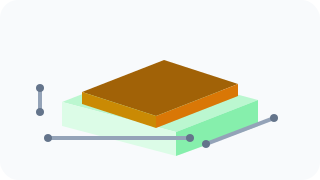
This box size works out to 40 cubic feet, which is useful for storage, moving, and freight estimates.
Mulch Bed
20 ft × 10 ft bed · 3 in depth
At a 3 inch mulch depth, this bed needs about 50 cubic feet, or roughly 25 standard 2 cu ft bags.

Gravel Base
12 ft × 12 ft area · 4 in depth
A small gravel base at 4 inches deep lands near 48 cubic feet, or about 3.6 tons of material.
How to Use This Calculator
Pick a Shape
Choose rectangle, circle, cylinder, or triangle to match your space.
Select Unit
Enter measurements in feet, inches, yards, meters, or centimeters.
Enter Dimensions
Type in length, width, and depth. Results update instantly.
Read Results
Get cubic feet, cubic yards, gallons, liters, and bag counts in one view.
How to Turn Dimensions Into Volume
1. Measure the shape
Start with the right dimensions for your space: length, width, and depth for a box or room; diameter and height for cylinders; or base, height, and depth for triangular spaces.
Volume = Length × Width × Depth 2. Convert everything into one unit
If your dimensions are in inches, yards, or metric units, convert them first or let the calculator handle it. Keeping all three numbers in the same unit is what makes the result usable.
1 cu ft = 1,728 cu in = 7.48 gal 3. Calculate cubic feet first
The main output is cubic feet. Once you have that number, the rest of the conversions are straightforward and easier to compare.
Example: 20 × 10 × 0.25 = 50 cu ft 4. Turn volume into a usable order number
After you have cubic feet, convert it into the unit that matters for the project: cubic yards for delivery, gallons for liquid capacity, or bag counts for mulch and soil.
50 cu ft ÷ 27 = 1.85 cu yd Volume math follows standard geometric formulas and common US construction conversions. Conversion factors per NIST Weights & Measures.